
Checked 10 September 2026
SlotLounge KYC and Account Verification in Australia
 Available in US
SlotLounge can require identity verification before processing a withdrawal. Its current Terms give examples of evidence that management can request, including identification, payment-system evidence and utility bills. They also allow video verification in some circumstances. These are official examples, not a guaranteed exhaustive checklist for every account.
If verification is necessary before a payout, the Terms state that a withdrawal can be held for up to 72 hours. That exact timing was rechecked on 10 September 2026. It is SlotLounge’s own KYC and withdrawal rule. It must not be confused with Australia’s customer pre-verification rules for licensed online wagering services, which operate under a different regulatory framework.
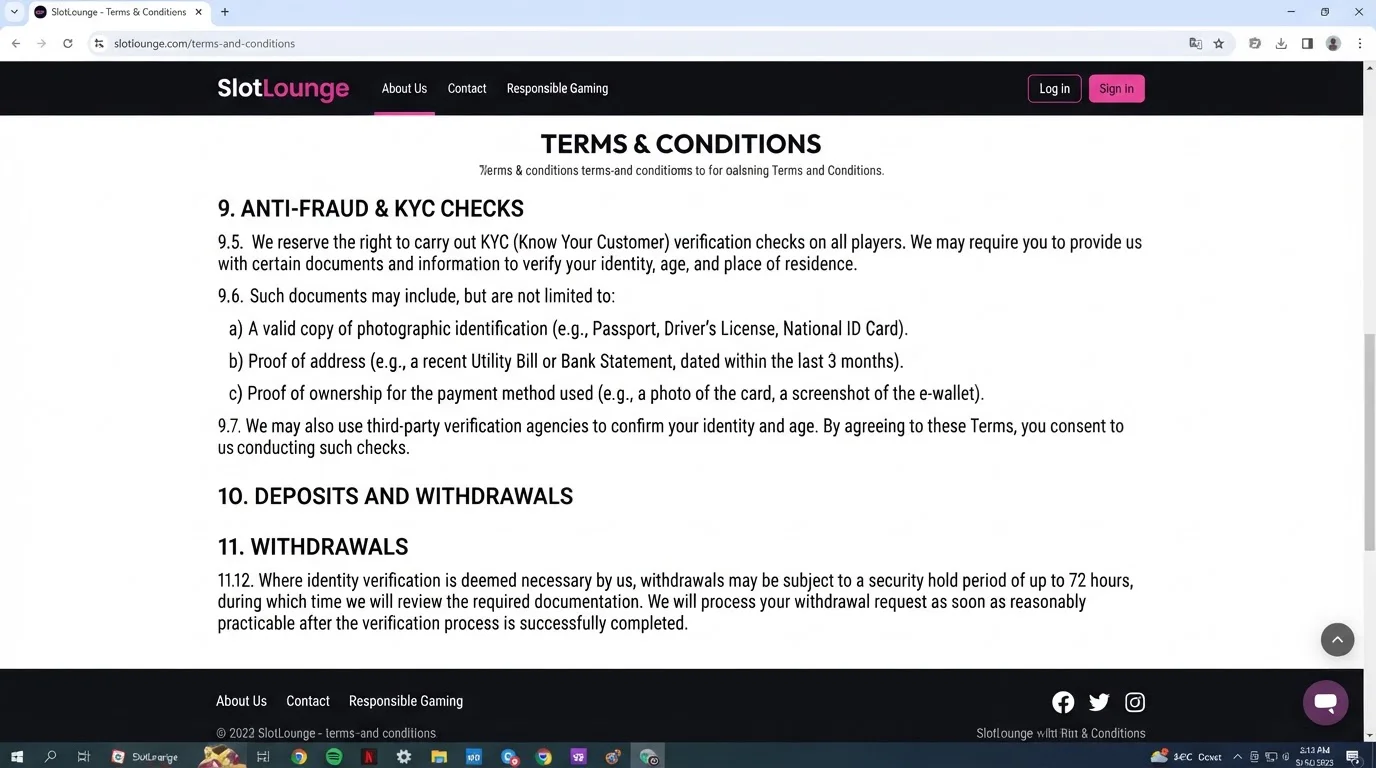
Table of Contents
- What SlotLounge KYC means in practice
- Official document examples, not a universal checklist
- When verification can affect a withdrawal
- How to prepare without over-collecting personal documents
- What the current Privacy Policy says SlotLounge processes
- SlotLounge KYC versus Australian licensed-wagering verification
- BetStop is not a SlotLounge KYC tool
- If verification is holding a cashout
- What KYC does and does not tell you about trust
- Current sources to check before uploading documents
- Verdict: expect a conditional KYC process, not one fixed checklist
What SlotLounge KYC means in practice
KYC is the identity-checking layer connected to account security, payment controls and anti-fraud rules. SlotLounge’s Terms say the casino can check a player’s identity before processing payouts. The anti-fraud section also says casino management can require documents to verify an account. Verification therefore matters most when the casino needs to establish that the person operating the account and requesting a withdrawal matches the information on record.
This page does not assume that every account receives the same request at the same moment. The official wording gives the operator discretion to check identity and provides examples of evidence. A successful signup is therefore not the same thing as having completed every verification step that could later be required. The registration guide covers the initial account rules and why accurate data matters from the start.
Official document examples, not a universal checklist
SlotLounge’s current Terms say casino management can require documents such as ID, payment-system evidence and utility bills. The same clause says documents are required in Latin or Cyrillic alphabet and allows the casino to demand video verification where the player cannot provide documents in those alphabets.
The Privacy Policy provides broader data context. It says SlotLounge processes account details including name, date of birth, contact information and government-issued ID for verification purposes. It also describes processing financial information such as payment details, deposits, withdrawals, winnings and transaction history, plus technical information including IP address, device type, browser, operating system and geolocation data.
Treat the document list as examples rather than a promise that every player will be asked for exactly those items and nothing else. The evidence needed can depend on the account, payment route and reason for review. This guide deliberately avoids inventing a fixed proof-of-address age limit, a universal selfie requirement or a guaranteed document turnaround time because the current official sources do not support those as universal rules.
When verification can affect a withdrawal
The current withdrawal policy gives the clearest trigger: SlotLounge reserves the right to check identity before processing payouts. If the casino needs that verification, the Terms say the withdrawal can be held for up to 72 hours. That hold belongs to the verification stage, not to the payment network after an approved payout has already left the casino.
SlotLounge also states that false or incomplete personal data can result in a refused withdrawal and account termination. Elsewhere, the Terms prohibit third-party deposits and require deposits to come from payment methods registered in the player’s own name. Those rules make consistency important: the registration identity, payment ownership and documents used for a review should all describe the same person and account relationship.
For the wider timeline, including the A$30 minimum, casino request-processing window and published withdrawal limits, use the withdrawal guide. This page stays focused on verification rather than repeating the whole payout policy.
How to prepare without over-collecting personal documents
- Keep the name, date of birth and residence details on the account accurate and consistent.
- Use payment instruments that belong to the account holder where the Terms require ownership matching.
- If asked for an image, make sure the requested document is readable and not cut off by the crop.
- Follow the exact request shown by SlotLounge rather than uploading unrelated sensitive documents in advance.
- Do not edit, manipulate or fabricate identity or payment evidence.
- Keep a copy of the support request and note when the verification request was made if a withdrawal is pending.
The goal is accuracy and legibility, not finding a shortcut around verification. Sending more personal data than requested can create privacy exposure without helping the review. Use the casino’s current secure upload or account process when one is specified, and do not send sensitive evidence to an address or chat account that you cannot confirm belongs to the operator.
What the current Privacy Policy says SlotLounge processes
SlotLounge’s Privacy Policy was last updated on 2 July 2026. It says Stable Tech N.V. processes account details, financial information, gaming activity and technical information. The listed account data includes name, date of birth, contact information and government-issued ID. Financial data includes payment details and transaction history, while technical data includes IP address and geolocation.
The policy says this information is used for purposes including account management, identity and age verification, payment processing, legal and regulatory compliance, fraud prevention and customer support. Those categories help explain why a KYC request can involve more than a single photo of an ID. They do not establish exactly which items will be requested from a specific Australian account.
SlotLounge KYC versus Australian licensed-wagering verification
Australia has a separate National Consumer Protection Framework for Online Wagering. The Department of Social Services states that the framework applies to licensed online wagering service providers and that customer identity must be verified when a new account is registered and before the customer can place a bet. That is a pre-verification rule for the Australian licensed wagering sector.
It should not be copied onto SlotLounge as though it were the source of this casino’s KYC process. ACMA describes BetStop as covering Australian licensed online and phone wagering services. SlotLounge’s own KYC rules come from its Terms and operator policies, while the Australian licensed-wagering rules describe a different regulatory system.
| Context | What the source says | What it does not prove |
|---|---|---|
| SlotLounge operator KYC | Identity can be checked before payouts; official Terms provide document examples and a conditional withdrawal hold. | It does not prove Australian licensing or BetStop coverage. |
| Australian licensed wagering framework | Licensed online wagering providers must pre-verify a new customer before betting. | It does not automatically govern an offshore online casino simply because a user is in Australia. |
BetStop is not a SlotLounge KYC tool
BetStop is Australia’s national self-exclusion register for Australian licensed online and phone wagering services. ACMA says a person who self-excludes is excluded from the licensed wagering providers covered by the register, and those providers have account, betting and marketing obligations.
That consumer-protection role is different from SlotLounge asking a player to prove identity for an account or withdrawal. It would be misleading to say that passing SlotLounge KYC enrolls a user in BetStop, that BetStop verifies a SlotLounge account, or that BetStop necessarily protects funds held at SlotLounge. For the wider legal distinction and ACMA enforcement framework, see the Australian legal status.
If verification is holding a cashout
Start by identifying what the casino has actually requested and whether the request is still incomplete. If support says a document is unreadable or does not match account information, correct the specific problem rather than repeatedly uploading different files. Keep communication records and ask whether the withdrawal itself remains pending, whether the account is considered verified and whether any further evidence is required.
Current third-party complaint indexes contain SlotLounge cases involving withdrawal verification and payment delays. They are useful as context that KYC can become a practical friction point, but individual complaints are not a substitute for the Terms and do not establish a normal verification duration. The strongest evidence remains the current operator wording and the status of the user’s own account.
What KYC does and does not tell you about trust
An identity check can be a legitimate account-control process, but the existence of KYC alone does not answer which local dispute protections apply. SlotLounge’s current Terms identify a Curaçao Gaming Authority licence; the separate Australian legal-status guide covers the local regulatory position.
For that reason, verification should be assessed on two separate questions: is the request consistent with the operator’s current terms, and what regulatory protection exists if the process turns into a dispute? The licence and trust handles the second question in detail.
Current sources to check before uploading documents
The exact KYC examples and 72-hour conditional hold on this page were rechecked against the current SlotLounge Terms. The data categories come from the current Privacy Policy. For the Australian licensed-wagering comparison, use the Department of Social Services gambling reforms page and ACMA’s BetStop information.
Verdict: expect a conditional KYC process, not one fixed checklist
SlotLounge’s current official sources support a straightforward conclusion: the casino can require identity verification before payouts, the Terms give document examples rather than a universal list, and a withdrawal can be held for up to 72 hours when verification is necessary. Accurate account and payment information therefore matters before a cashout request reaches this stage.
For Australians, keep SlotLounge’s operator KYC separate from the pre-verification and BetStop rules that apply to Australian licensed wagering services. They are different systems with different scopes. Return to the SlotLounge Australia review for the wider product and regulatory context.
Written by the editors at Slotlounge Casino.