
Separate payment claims from verified details
A USDT mention alone does not establish cashier availability, Australian eligibility, network support or transaction terms.

Table of Contents
- What “Online Tether Casino” Searches Can—and Can’t—Confirm
- How to Read “Best Tether Casino” Claims Without a Verified Shortlist
- Live Play and No-Deposit Claims Need More Than a USDT Label
- Bonus and Free-Slot Searches: Check the Claim, Not the Promise
- Casino Games and USDT Payments Are Separate Questions
- TRC20 in Australia: The Network Details Aren’t Verified Here
- What Australian Law Means for Searches for USDT Casinos
- Before You Play: Payment Habits in Australia
- Live Dealer Searches Don’t Verify a Casino’s Legal Status
- Deposits, Withdrawals and the Missing USDT Processing Details
What “Online Tether Casino” Searches Can—and Can’t—Confirm
A Tether label can tell you what a page claims to support. By itself, it does not establish that an online casino accepts USDT from people in Australia.
That distinction matters because search results often compress several separate ideas into a few words. “Tether casino online” might refer to a site that mentions USDT, a page discussing cryptocurrency payments, or an operator claiming to support the currency. Those are not equivalent. A mention is not confirmation that the option appears in the cashier, applies to Australian customers, or remains available when someone tries to transact.
The same care applies when a page combines Tether with “live” or “mobile”. Those words can describe the page’s intended audience or its marketing, but they do not independently verify the payment arrangement. Nor does a familiar-looking currency symbol settle who operates the service or whether the stated terms apply to a particular customer. The label is only one piece of a claim.
A neat list is not useful if the entries have not been established.
Top operators
Top operators
If you’re looking for casinos to consider for Tether USDT in Australia in 2026, this list gives you a concise reference to the details available for each operator. Check each casino’s current payment options and terms before depositing.
-
LevelUp Casino
- License
- Curacao eGaming OGL/2023/174/0082 (Dama N.V.)
- Min. deposit
- A$15
You can note its Curacao eGaming licence, listed under Dama N.V. Its minimum deposit is A$15.
-
Ricky Casino
- Payout speed
- crypto under 1 hour, PayID 1-3 business days
- Min. deposit
- A$20 (A$30 to qualify for the bonus)
You can expect crypto payouts in under an hour, while PayID payouts are listed at 1–3 business days. The minimum deposit is A$20, or A$30 to qualify for the bonus.
-
Golden Pokies
- License
- Curacao
The available detail for you is its Curacao licence.
-
SkyCrown
- License
- Tobique Gaming Commission
- Payout speed
- crypto ~10-15 minutes, fiat 1-5 days
- Min. deposit
- A$30
You can note its Tobique Gaming Commission licence and listed crypto payout time of about 10–15 minutes; fiat payouts are listed at 1–5 days. Its minimum deposit is A$30.
-
GoldenCrown
- License
- Curacao Gaming Control Board OGL/2023/176/0095 (Hollycorn N.V.)
You can note its Curacao Gaming Control Board licence, OGL/2023/176/0095, listed under Hollycorn N.V.
-
SpinsUp
- License
- Curacao Gaming Control Board OGL/2023/174/0082 (Dama N.V.)
You can note its Curacao Gaming Control Board licence, OGL/2023/174/0082, listed under Dama N.V.
-
Thor Casino
- License
- Curacao – Antillephone N.V. (Versus Odds B.V.)
- Min. deposit
- EUR 20
You can note its Curacao licence, listed under Antillephone N.V. (Versus Odds B.V.). The minimum deposit is EUR 20.
-
Rollero Casino
- License
- Curacao Gaming Control Board OGL/2023/176/0095 (Hollycorn N.V.)
You can note its Curacao Gaming Control Board licence, OGL/2023/176/0095, listed under Hollycorn N.V.
-
DragonSlots Casino
- License
- Curacao Gaming Authority (Jumpman Gaming Ltd)
You can note its Curacao Gaming Authority licence, listed under Jumpman Gaming Ltd.
-
Kingmaker
- Payout speed
- crypto ~90 minutes, fiat 1-5 days
- Min. deposit
- A$30
You can expect crypto payouts in about 90 minutes, while fiat payouts are listed at 1–5 days. Its minimum deposit is A$30.
A sensible way to read a payment claim is to ask what exactly it asserts. Does it say that USDT is accepted, or only that the operator discusses cryptocurrency? Does it specify Australian customers, or speak generally? Is the claim current and tied to the operator’s own terms, rather than repeated on another page? If those details are unclear, the claim remains unclear. You do not need to turn uncertainty into a verdict about every other part of the site; just don’t treat the payment wording as settled fact.
There is another step that can surprise people who assume a digital payment label means an immediate, anonymous transaction. Online casinos commonly ask customers to complete a Know Your Customer assessment before they handle financial transactions. That identity-check process is separate from the name of a payment method. Seeing USDT mentioned does not mean that identity checks disappear, or that a customer can skip the operator’s assessment.
Keep that in mind before sharing personal details. A payment claim and a request for identity documents are different matters, and the first does not explain the second. Read what the service says about its assessment process and how it handles customer information. If the explanation is absent or difficult to understand, that is a reason to pause rather than infer that a familiar crypto term makes the process straightforward.

The phrase “Tether casino in Australia” can also be read too broadly. It may sound as if it identifies a locally established service, but the wording alone does not prove where an operator is based, who it serves, or whether it has a genuine Australian presence. Likewise, “Tether online casino Australia” is not a substitute for checking what the claim actually means. Search phrasing is shorthand, not a description of verified status.
I’d be especially wary of treating several repeated mentions as several independent confirmations. Pages can repeat the same claim without adding evidence. A payment logo, a promotional sentence and a copied list may all trace back to one untested assertion. Repetition makes a claim more visible; it does not make it more reliable. Dry point, but worth keeping.
What can be said is narrower: payment labels need context, and identity checks may still be part of financial transactions. Keep those two points separate, and don’t let a currency name do more work than it can.
How to Read “Best Tether Casino” Claims Without a Verified Shortlist
A “best” label sounds like a recommendation, but it only means something when you can see what was compared and how. For a Tether casino in Australia, a ranking should be based on identifiable operators and details that can be checked against one another. Without that foundation, a numbered list is just an order on a page.
I would not treat a polished ranking as proof that a site accepts USDT, or that it is suitable for Australian players. Look for concrete, operator-specific information: does the cashier actually show Tether, and are the stated conditions current? A logo, a broad cryptocurrency claim or a paragraph repeating “fast and easy” cannot answer those questions by itself.
Do
- Check if the operator is named specifically
- Look for Tether-specific acceptance claims
- Verify if information applies to Australians
- Confirm details against the operator's cashier
- Check the date and criteria of the ranking
Don't
- Rely on a site described only as a "top site"
- Accept general cryptocurrency claims as USDT proof
- Assume general claims apply to Australian users
- Trust payment details not found in the cashier
- Trust a ranking without clear dates or criteria
There is a difference between naming a payment method and checking how a particular operator handles it. A site might mention cryptocurrency without saying whether Tether is included, or which network is supported. Even a visible USDT reference would not, by itself, tell you the terms for deposits and withdrawals. Those are claims that need to be tied to the operator, not inferred from a headline.
A useful comparison also needs the same kinds of details for each entry. If one listing gives a payment method, another gives a bonus, and a third offers only a star rating, they are not being assessed on equal terms. Nor does an attractive score tell you whether the information was checked recently. “Latest” is not a meaningful quality measure unless the underlying details and date are clear.
The same caution applies to a supposed list of Tether sites. A list can look substantial while giving you no basis to judge whether entries are active, whether their payment options apply to Australians, or whether the descriptions match the cashier. Repeating operator names does not turn a claim into a comparison. I would rather leave a ranking blank than dress uncertainty up as a winner.

Payment comparisons can still be useful, but they answer a narrower question. A specialist review has reported that Visa may be accepted at more Australian online casinos than Amex. That is a limited comparison between card methods, not evidence that any named casino accepts Tether, and it cannot be used to rank USDT sites. Payment availability can differ from one operator to another; a general observation should not be stretched into a promise about a particular cashier.
Be wary of rankings that blend unrelated features into one score. Games, promotions, payment methods and customer support are separate matters. A page that praises a bonus does not thereby establish that USDT is accepted; a payment badge does not confirm what games or terms apply. Those details need their own evidence. Otherwise, the “best” label does too much work.
You can use a few simple checks when assessing a claim:
- Is the operator named, rather than described only as a “top site”?
- Does the claim say that Tether is accepted, rather than cryptocurrency in general?
- Is the information specific to Australian customers?
- Are the payment details attributed to the operator and consistent with what the cashier displays?
- Can you tell when the claim was checked, and what criteria were used to rank entries?
If those points are absent, do not fill the gaps with assumptions. A list may still be useful as a starting point for checking a claim, but it is not an endorsement and should not be treated as one. A high placement is not a payment confirmation.
Nor does a bonus heading make a site a better Tether option. A promotion may have separate eligibility and payment terms, and a headline cannot settle either. The same goes for references to pokies or other games: they do not establish which payment methods are available. Keep each claim in its lane.
My rule is simple: trust the detail, not the adjective. A credible comparison should make clear what was checked and what its conclusions actually cover. If it slides from “accepts cryptocurrency” to “best Tether casino in Australia” without showing the link between those statements, the ranking has outrun its evidence. That is not a shortlist; it is a sales pitch wearing a scorecard.
Live Play and No-Deposit Claims Need More Than a USDT Label
A page can put “live” and “USDT” beside each other without showing that a particular service accepts Tether, offers live play, or is available to people in Australia. Those are separate claims, even when they appear in one headline. I would not treat the combination as proof.
The same goes for “best” language. It is a judgement, not a checkable detail by itself. To support it, a claim would need a clear basis: what was assessed, when it was checked and whether the information applies to Australian users. Without that context, “best online casino with Tether” tells you what the page wants you to believe, not what has been established.
“No deposit” needs the same careful reading. The phrase can sound like a simple offer, but seeing it next to USDT does not establish that an offer exists, that it is current, or that it applies to a particular reader. Nor does it confirm that a service is accepting customers in Australia. A prominent label is still just a label.
I separate these points when I read a claim:
- The payment claim: does the page actually establish that USDT is accepted?
- The live-play claim: is there evidence that the described live service is available?
- The offer claim: is a no-deposit promotion confirmed, and does it apply to the person reading?
One claim cannot fill the gaps in another. A mention of Tether does not prove live play; “live” does not verify a payment option; and an offer headline does not establish either one. Three labels in a row do not make a verified service.
Be wary of pages that present the wording as a finished recommendation but leave out who the information covers. A reader in Australia needs more than a general statement about an online service: the claim must actually address Australian availability. A vague “players can” or “available now” may refer to a different audience, a past listing or a page that has not been updated. If the location and date are unclear, there is no sound basis for treating the statement as current for you.
I also look for the difference between a page describing an offer and a page merely repeating its name. If it offers no clear explanation of what is being claimed, the headline cannot settle the matter. That is not a minor detail. Offers are the sort of thing that can change, disappear or be described differently across pages.
This is especially worth remembering when several attractive terms are bundled together. A site may be described as a top Tether casino, a live option and a no-deposit choice all at once. Each description still needs support on its own. A combined pitch can make the package feel more certain than any of its parts. Neat wording, thin evidence.
So read the wording as a set of claims to verify, not as confirmation that a service or promotion is ready for you. If the page does not clearly establish what it means, who it applies to and whether it is current, the sensible conclusion is limited: the wording makes a claim, but does not prove it.
Bonus and Free-Slot Searches: Check the Claim, Not the Promise
A welcome offer, a deposit match or a “free” play label can sound straightforward. The wording alone tells you very little. It does not establish who is eligible, whether a deposit is required, what conditions attach to a promotion or whether a payment method such as USDT qualifies. Those details would have to be stated in the offer’s terms; a headline is not a substitute.

The same goes for claims about no-deposit bonuses. “No deposit” describes one part of an offer, not necessarily its full conditions. Before treating any promotion as real or usable, you would need clear terms covering eligibility, any play-through requirements, expiry, withdrawal conditions and excluded payment methods. If those terms are absent, unclear or inconsistent with the headline, you cannot sensibly judge what the offer means. A neat label is not a neat deal.
That applies to claims linking USDT with free plays or a casino welcome offer, too. A page using “Tether” in its promotional wording does not by itself show that USDT is accepted, that the offer is available to Australians, or that the advertised terms apply to you. Don’t infer a payment option or a bonus from the same marketing phrase.
There is a more basic point for Australians. Under the Interactive Gambling Act 2001, operators cannot provide real-money online casino games to people physically in Australia. The Australian Communications and Media Authority is responsible for enforcing that law. An offer attached to an offshore service does not change the legal position, and Australian consumer law does not protect players who use offshore casinos.
So treat bonus language as a claim to assess, not an invitation. Check whether the full terms are visible and whether they answer the practical questions above; if they do not, the headline cannot fill the gaps. Avoid promotional pages that push urgency or present an offer as a reason to sign up. In Australia, promotion rules for gambling services are restricted, and online casino advertising is not a harmless way around the underlying prohibition.
I would keep the distinction clear: a bonus claim is not proof of an available offer, and an offer is not proof that a service may lawfully provide online casino games to Australians. The phrase “free” settles neither point. A promotion can be dressed up in friendly language while leaving the important conditions out of sight. If you cannot see what the terms actually say, there is no sound basis for relying on the promise.
Casino Games and USDT Payments Are Separate Questions
A payment label and a game catalogue describe different things. Seeing USDT mentioned beside casino games does not establish that a particular game is available to Australian residents, that it can be funded with Tether, or that the service may lawfully offer it here. Those claims need to be assessed separately.
That distinction matters because a payment method cannot change the legal status of the service receiving it. A site might describe a product as a Tether casino game or suggest that you can play casino games with Tether, but the currency named in that description says nothing about whether the underlying online casino service is permitted in Australia. Nor does it prove that the game itself has a supported USDT payment route.
For people physically in Australia, the Interactive Gambling Act 2001 makes it illegal for operators to provide real-money online casino games. The rule covers casino-style services, not just the way a customer pays. The Australian Communications and Media Authority, or ACMA, oversees enforcement of that law.
The legal position for players is different from the position for operators: the Act does not explicitly make a person’s use of an offshore site a criminal offence. That is not the same as approval, endorsement or protection. Australian consumer law does not protect players who use offshore casinos, so a dispute over an account or payment may leave you without the protections you would expect from a domestic service.
This is where wording such as “Tether games” can blur two separate questions. One is whether a service claims to accept USDT; another is whether it offers real-money casino games to Australians. A crypto payment does not create an exception to the law. Likewise, describing a game as a digital product does not change the nature of a real-money gambling service.
I would treat claims that a game “uses” Tether with care, too. That phrase might refer to the way an account is funded, rather than a feature of the game. Without clear, independently checkable details, it should not be read as proof that USDT is integrated into a particular game or that the service is lawful for Australians.

The same caution applies when a site groups games and payment claims together in promotional wording. A bonus or payment label cannot establish that the underlying offer is available, lawful, or protected under Australian law. Keep the questions separate: what the service claims to provide, how it says payments work, and whether operators may provide that service to people in Australia.
The legal line is plain, even when the wording is not.
TRC20 in Australia: The Network Details Aren’t Verified Here
TRC20 is a network label, not a guarantee that a payment route is available to you. Seeing it beside USDT on a page does not, by itself, establish that an Australian user can send funds there, that the destination supports the same network, or that a service is operating lawfully for people in Australia.
That distinction matters when you come across claims about an Australian Tether casino or a real-money casino using USDT. The currency name and the network name answer different questions: USDT identifies the token, while TRC20 identifies a network on which it may be transferred. Neither label confirms who operates a service or what its payment process allows.
Before treating a payment instruction as usable, you would need clear, service-specific information about the accepted network, the receiving address and the steps for handling a transfer. A mismatch between the network selected in a wallet and the one expected at the destination can make a transfer difficult to recover. Don’t assume that an address or instruction applies across different networks just because the token is called USDT.
The same caution applies to wallet procedures. A page may mention a deposit route without explaining whether the wallet and destination are compatible, how a transaction is identified, or what happens if a payment needs attention. Those details cannot be inferred from the words “USDT,” “TRC20” or “casino” appearing together. A label is not a procedure.

There is a broader cryptocurrency comparison, but it should not be stretched into a claim about Tether. Bitcoin and Ethereum are described as offering instant deposits and withdrawals with limited or no fees. That general point does not establish the speed, cost or availability of a USDT transfer on TRC20, nor does it confirm that a particular Australian-facing service accepts it. Different asset, different route.
So if you are trying to work out whether a USDT TRC20 casino is a real, usable option in Australia, separate three things: the token, the transfer network and the operator. A page that names one does not automatically confirm the other two. I would not treat a search result or a payment badge as proof of a working deposit method.
Keep the wording literal. “USDT accepted” is not the same as “USDT on TRC20 accepted,” and either statement is still only a payment claim. It does not settle the operator’s status, the applicable terms or whether the service can lawfully be offered to people in Australia. The network detail is only one part of the picture. No shortcuts.
What Australian Law Means for Searches for USDT Casinos
A Tether payment label does not alter the legal position of an online casino serving people in Australia. Under the Interactive Gambling Act 2001, operators must not provide real-money online casino games to people physically located here. The rule covers casino-style services regardless of whether a site describes itself as a crypto casino or accepts USDT.
That distinction matters when you come across a claim about a casino that accepts Tether. A payment method is not a licence or an exception to the law. The relevant issue is whether an operator is providing a prohibited online gambling service to customers in Australia, not which currency or token appears in its cashier.
The Australian Communications and Media Authority, or ACMA, oversees enforcement of the Act. Its role is directed at the law’s restrictions on providers; the Act does not explicitly make an individual player’s use of an offshore site a criminal offence. That narrower point is not an invitation to play. It describes the difference between the obligations placed on operators and the position of users.
There is another practical limit to keep in view: Australian consumer law does not protect you when you use an offshore casino. If a dispute arises, you cannot assume the safeguards and remedies available in a locally regulated consumer transaction will apply. That is a substantial gap, not a minor detail in the terms and conditions.
People looking for an online casino with USDT may see a site’s Australian-facing wording and take it as evidence that the service is lawful here. It is not. Nor does a Tether option make a prohibited service acceptable under Australian law. Keep the payment claim and the legal question separate.
I would not treat a site’s availability, branding or payment menu as proof that it can lawfully offer casino games to Australians. The legal framework is about the service provided to people in the country; a cryptocurrency label does not change that. ACMA’s enforcement role sits within that framework, while the absence of explicit criminalisation of players should not be mistaken for consumer protection or official approval.
Plainly put: the operator’s legal restriction and the player’s exposure are not the same question. A search result can blur them together. Don’t.
Before You Play: Payment Habits in Australia
For everyday purchases in Australia, tapping a card is unremarkable. Contactless credit and debit cards are accepted almost everywhere, and mobile wallets such as Google Pay and Apple Pay are just as familiar at the checkout. That is a useful picture of daily payment habits—not evidence that those methods, or any particular digital currency, are available for a specific service.
People here are also comfortable moving between payment types. You might use a card for one purchase, a phone wallet for the next, or a service linked to a bank, such as PayPal. The choice often comes down to what you already use and what the merchant accepts. No grand theory required.

That everyday flexibility can make a Tether-labelled casino seem like one more payment choice to compare. But familiarity with tapping a card or opening a mobile wallet does not tell you whether a particular online service accepts Tether, what conditions it applies, or whether using the service is lawful. A familiar payment habit is not a verification tool.
I’d keep those questions separate. First, consider the payment methods you already use in ordinary transactions and how comfortable you are managing them. Then, treat any claim about a casino’s payment options as a separate claim that needs direct, current confirmation. A logo or a general statement about cryptocurrency is not the same as clear terms for a specific service.
It also helps to notice what “widely accepted” actually means. Contactless cards and major mobile wallets are common across Australian everyday commerce; that does not mean every business accepts every method, or that acceptance carries over from a shop to an online platform. Even with familiar services, the merchant’s own payment arrangements matter.
So if you are weighing the idea of playing with Tether against the way you normally pay, use everyday Australian habits only as a point of comparison. They can tell you what feels familiar to you. They cannot establish a casino’s payment support, account requirements, or legal standing. Keep the distinction clear. Familiarity is not proof.
Live Dealer Searches Don’t Verify a Casino’s Legal Status
“Live dealer” describes how a game is presented: a dealer appears on screen and play is streamed in real time. It does not tell you whether the service may lawfully be offered to people in Australia. Adding Tether, USDT or a crypto payment label to that description changes nothing about the legal question.
The key distinction is between the way a game is delivered and whether an operator is permitted to provide it here. Under the Interactive Gambling Act 2001, operators cannot offer online casino games to people in Australia. A live presentation does not create an exception. Nor does a site’s own description of its service settle its status.
That is easy to miss when the wording puts the dealer, the payment method and the game in one neat package. They are separate claims. “Live dealer” is not proof of lawful availability; “accepts USDT” would not be proof either. A polished stream is still just a stream. Dry, but important.
The law’s position on operators should not be confused with the position of individual players. The Act does not expressly make a player’s use of an offshore site a criminal offence. That does not mean an offshore service is approved, or that Australian consumer protections apply. Australian consumer law does not protect players using offshore casinos, so a familiar format or payment label should not be mistaken for local oversight.
I would treat any live-dealer description as a feature claim, not a legal assurance. It says nothing by itself about whether a service is allowed to target people in Australia, whether the games may be supplied here, or what protections a player can rely on. The stream can show you a dealer; it cannot establish the operator’s legal position.
For an Australian reader, the practical point is simple: live presentation and crypto terminology do not change the restrictions on online casino services. Don’t read a game label or payment badge as permission.
Deposits, Withdrawals and the Missing USDT Processing Details
A claim that a casino supports USDT deposits tells you little about how a later withdrawal would work. Deposit acceptance, withdrawal availability and processing time are separate details. A payment option appearing at the cashier does not, by itself, establish that winnings can be returned through the same route or explain what conditions might apply.
You may see cryptocurrency described as offering instant deposits and withdrawals with limited or no fees. That general comparison refers to cryptocurrencies such as Bitcoin and Ethereum; it is not a timing or fee guarantee for USDT at a particular service. Nor does the phrase “instant withdrawal” tell you when a payment is approved, when it is sent, or when it becomes available to the recipient. Those are different stages, and a headline can blur them.
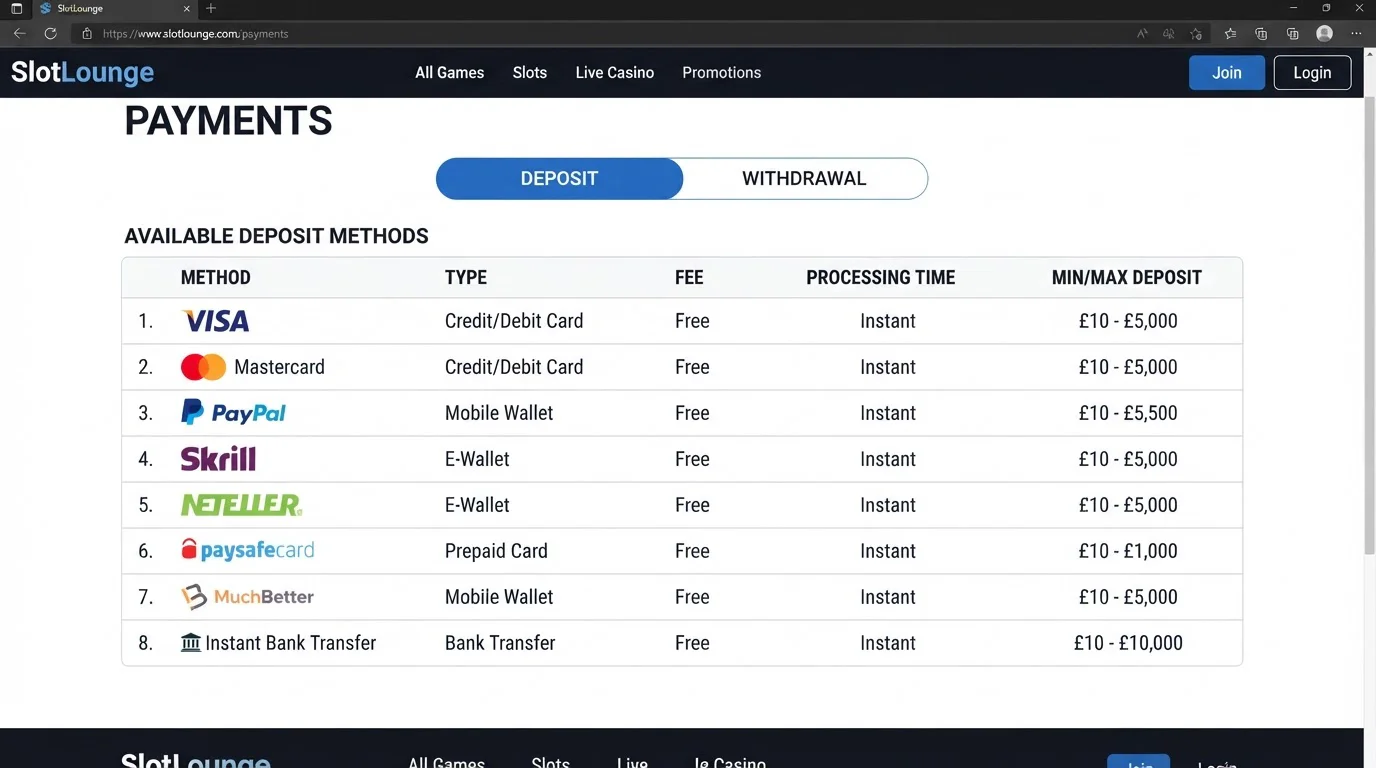
Bank transfers are sometimes presented as a slower, more expensive alternative. A specialist payment review notes that transfers may involve longer waits and higher fees, but that observation does not establish a universal rule. It also cannot be used to calculate how a USDT transaction would compare. Different payment methods are not interchangeable just because they appear in the same comparison.
The same caution applies to talk of a fast tether withdrawal. Without clear, specific terms, you cannot tell whether a stated speed concerns processing or receipt, or whether fees or other conditions affect the outcome. A deposit-only mention is not evidence of a withdrawal route.
For anyone assessing these claims, the useful distinction is simple: a payment method being named is not the same as a complete account of deposits and withdrawals. Treat speed and fee language as a claim about a particular transaction, not a feature that automatically follows from using cryptocurrency. No shortcut there.
How do you check if casino sites accept Amex deposits?
Check whether American Express appears as a deposit option in the casino’s cashier, and confirm that the option applies to Australian customers.
What are the deposit and withdrawal limits at the best Amex casinos?
Each casino sets its own Amex deposit and withdrawal limits, so check the cashier or the casino’s payment terms. Amex limits are usually higher than those for Mastercard and Visa.
Can I withdraw winnings directly to my American Express card?
Some casinos do not allow withdrawals to Amex, and you generally need to have deposited with Amex first. Where available, withdrawals can take up to five days to clear, and a fee may apply.
What are the security tips for using American Express?
Before sharing identity documents or card details, read the casino’s explanation of its checks and how it handles customer information. Pause if that explanation is missing or difficult to understand.
Are there any fees for depositing with American Express?
Amex deposits are typically free, but a casino may apply a 1.5% surcharge, and a 3% currency conversion fee may apply. Withdrawal fees may also apply.
Which online casinos accept American Express for deposits?
Jackpot City Casino, Spin Palace, Ruby Fortune, Ignition Casino, Joe Fortune and PlayAmo are listed as accepting Amex deposits for Australian players. Confirm the option in each casino’s cashier before depositing.
How can I know if an online casino will accept American Express?
Look for Amex in the casino’s cashier and check its payment terms for Australian customers. Some casinos do not accept Amex, and an issuer may also block a payment to a particular website.
Created by the ”Slotlounge Casino” editorial team.